Penile Lengthening Surgery in China
Release time: 2026-10-13
More visible length starts with understanding your anatomy
When you consider penile lengthening, the change you want is personal. It may be more shaft visible at rest, a different appearance at the base, or help with tissue that conceals or pulls on the penis. A useful treatment plan starts there—not with a fixed number of centimetres promised to everyone.
At Chongqing Shinrong Plastic Surgery Hospital, Professor Li Shirong’s team assesses lengthening within a wider genital reconstructive service. We perform suspensory ligament release and, where appropriate, combine it with skin procedures or treatment of the suprapubic fat pad. The aim is to match the approach to the reason the shaft looks short.
Tell us what you would like to change. A private assessment can establish whether lengthening is a reasonable option and which part of your anatomy the treatment would address.
WhatsApp: +86 18983690960
What can lengthening change?
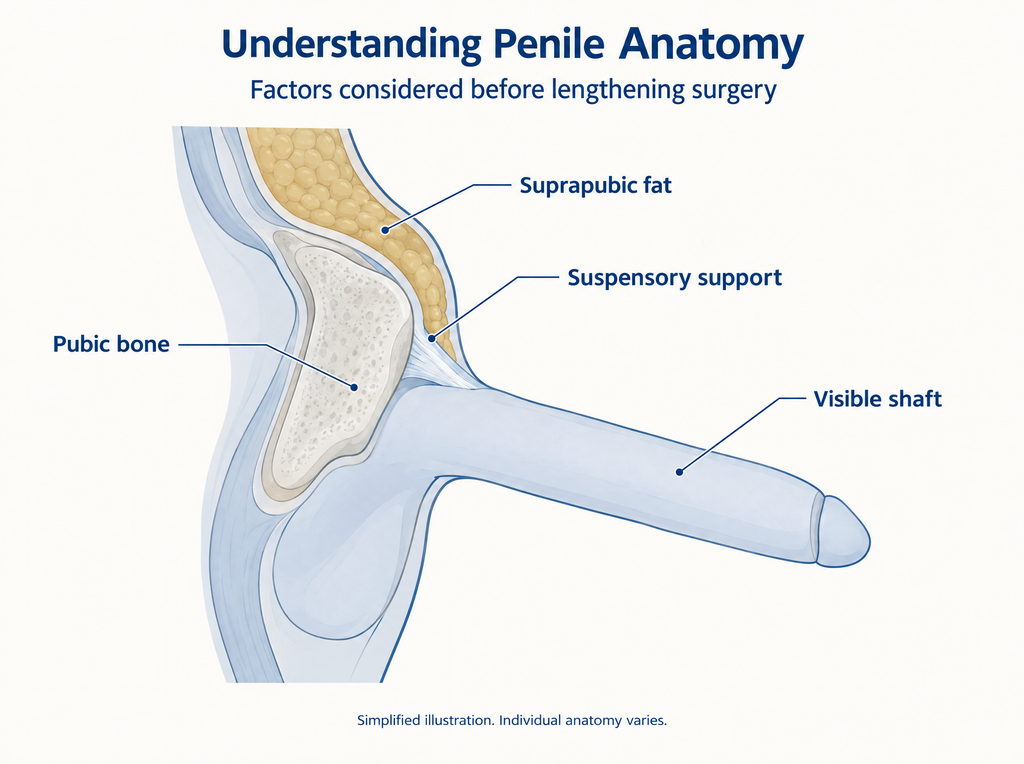
Visible length and erect length are not interchangeable. Releasing a supporting attachment may alter the way the penis projects externally, particularly at rest. Treating surrounding fat or skin can expose more of a concealed shaft. Neither approach creates new erectile tissue, and an increase in visible length does not establish an equal gain during an erection.
This distinction helps explain why two men with similar-looking photographs can need different plans. One may have a substantial suprapubic fat pad. Another may have limited skin, webbing or scarring. Someone whose main concern is erect length may have very little concealed shaft to expose.
The examination makes the discussion specific. It identifies what is limiting exposure and whether the proposed change is likely to address your goal.
How Shinrong plans the procedure
Suspensory ligament release
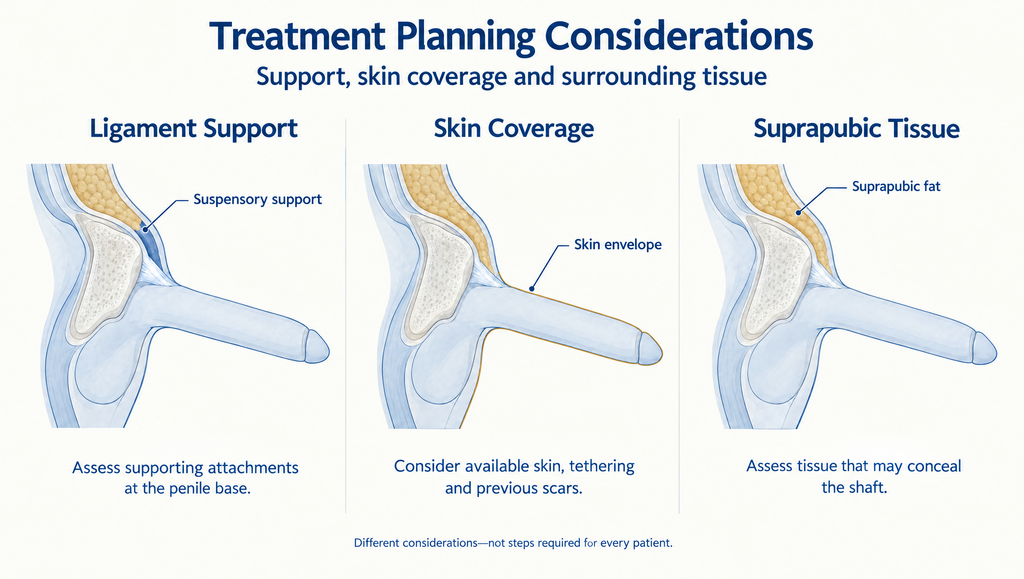
The suspensory attachment supports the penis at the pubic region. Releasing selected structures can allow a change in external projection. The extent of release must be planned carefully because support and erection stability also matter.
Skin advancement or flap coverage
Skin has to accommodate the intended change. Where coverage is limited—for example, after previous surgery—a plan may involve advancement of nearby skin or a flap. V–Y advancement is one way of rearranging skin; a flap moves living tissue with its blood supply.
Professor Li’s work on a modified scrotal-flap approach dates to 1991. That reconstructive background is relevant when the problem involves coverage or scarring as well as apparent length.
Suprapubic fat treatment
If tissue above the base conceals the shaft, suprapubic liposuction or another tissue-management approach may be considered. It is selected for the anatomy, not automatically added to every lengthening operation. A buried penis can also involve diseased or scarred skin and may require a broader reconstructive plan.
An anti-adhesion spacer may be considered in selected cases. Its purpose, exact material and evidence should form part of the treatment explanation; it is not a guarantee against reattachment or loss of an early improvement.
How will the result be measured?
Shinrong’s assessment distinguishes length at rest, stretched length and erect length. These measurements should be recorded separately and compared using a consistent method. Suprapubic tissue, temperature, tension and erection quality can otherwise change the apparent result.
For a patient, the practical point is simple: the measurement used to describe your goal should also be used to assess the outcome. A larger flaccid measurement is not proof of increased erect length, and an immediate postoperative photograph is not a settled result.
No universal gain is promised. If you review before-and-after examples, look for the same measurement state, comparable photography and a clear follow-up interval. Cases help explain what was done; they do not predict exactly what will happen for you.
Recovery that fits the actual operation
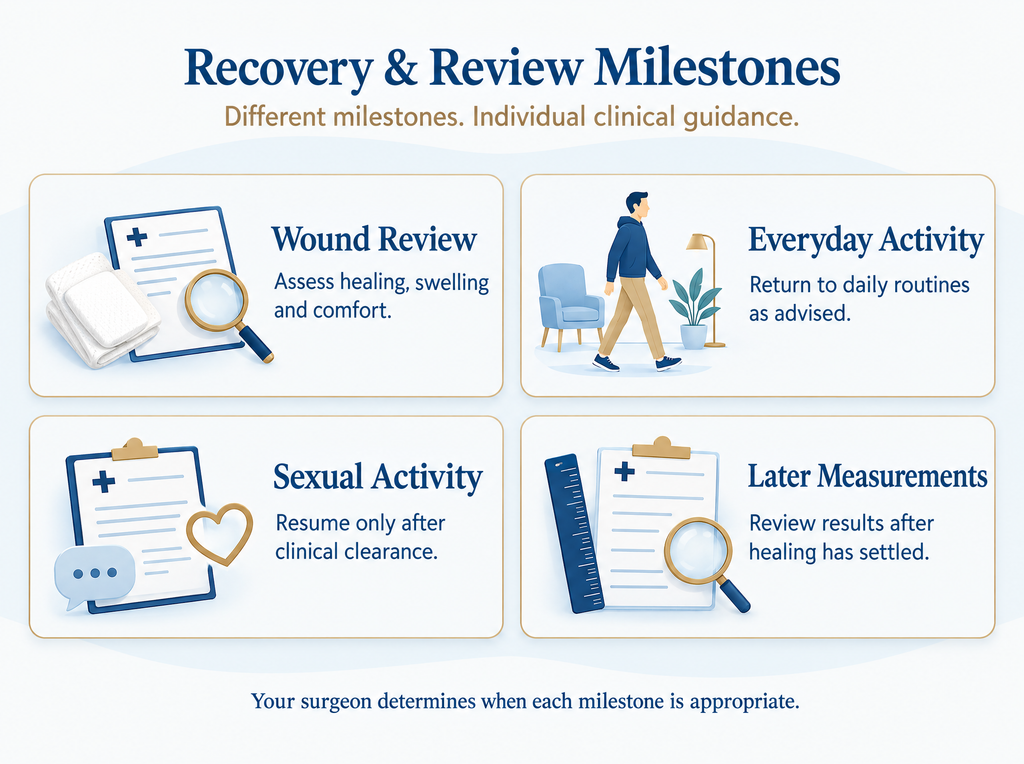
Leaving hospital, returning to work and resuming sex are different milestones. A plan involving flap coverage or revision can require different care from a more limited procedure.
Before discharge, you should know how to look after the wound, when it will be reviewed and what activities to avoid. Desk work, lifting, cycling and sexual activity place different demands on healing tissues. Any traction or support device must follow the treating surgeon’s instructions; improvising with weights or stretching can cause harm.
For international patients, interpretation can be arranged and the visit should include time for the recommended local review. Confirm the care plan before fixing your departure date. A short inpatient stay is not, by itself, clearance to fly or resume normal activities.
Benefits need to be weighed against real risks
Lengthening can change appearance in selected patients, but it is not a guaranteed treatment for sexual performance or body-image distress. Possible complications include bleeding, infection, wound-healing difficulties, visible scars, altered sensation and dissatisfaction. Ligament release can affect erection support or stability; erectile difficulties and reattachment-related loss of exposure are also possible.
Severe or increasing pain, fever, significant bleeding, unusual skin darkening or difficulty urinating need prompt medical assessment. Do not wait for an overseas message if urgent local care is needed.
Common questions about lengthening
Does lengthening also increase girth?
Not reliably. Girth enhancement is a separate intervention with its own benefits, risks and evidence. It should not be assumed to be part of a lengthening procedure.
Will there be a scar?
An incision leaves a scar. Its position depends on the technique and any skin work; its later appearance depends on healing. A concealed incision is not the same as a scarless operation.
Discuss your options with Professor Li’s team
If you are considering lengthening for the first time, describe the appearance you hope to change. If you have had previous treatment, bring the operative report and material details where available. That information helps distinguish a primary procedure from a revision assessment.
Contact Chongqing Shinrong Plastic Surgery Hospital
WhatsApp: +86 18983690960
Email: shinronghospital@gmail.com
Online enquiry: Contact Shinrong
An individual assessment is required to determine suitability, the proposed technique and realistic expectations.
- More visible length starts with understanding your anatomy
- What can lengthening change?
- How Shinrong plans the procedure
- How will the result be measured?
- Recovery that fits the actual operation
- Benefits need to be weighed against real risks
- Common questions about lengthening
- Discuss your options with Professor Li’s team
Chongqing Shinrong Plastic Surgery Hospital
U 2-1 Beicheng International Centre 88
Longhuan street Yubei Dist rict chongqing CN
Proudly powered by WordPress