


Penile Girth Enhancement Surgery in China
Release time: 2026-10-13
Circumference, proportion and feel—not simply “bigger”
When men ask about penile girth enhancement, the questions usually go beyond a measurement: how could the appearance change, how might it feel, and what would recovery involve?
At Chongqing Shinrong Plastic Surgery Hospital, the first distinction is between adding volume with an injectable treatment, transferring your own fat and placing a tissue-derived graft. These are different procedures with different evidence and risks. Understanding which one is being discussed is essential to a meaningful comparison.
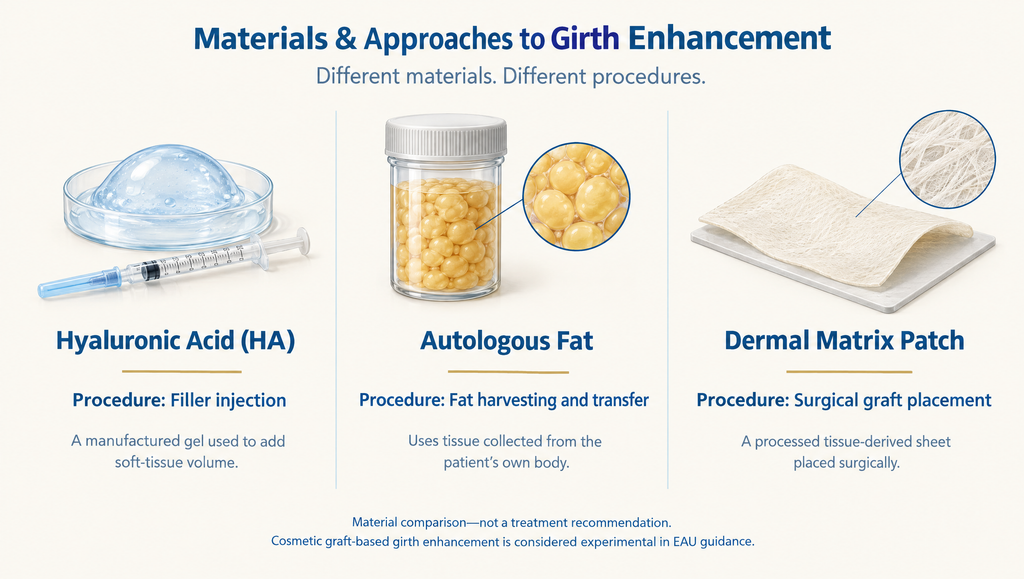
A consultation with Professor Li Shirong’s team can help relate those options to your anatomy and goals. It should also make an important limitation clear: the European Association of Urology considers graft-based cosmetic penile girth enhancement experimental and recommends against its use. This must be part of the decision, not a detail omitted from a treatment offer.
Start with the type of change you want
Girth means circumference—the distance around the shaft—not diameter. A change in circumference should not be described as the same increase in width.
Proportion also matters. A plan may need to consider skin quality, the existing contour and any previous treatment rather than simply adding the largest possible amount of material. Early swelling is not the final shape, and a result measured at rest cannot automatically be compared with an erect measurement.
The useful goal is a clearly defined change in the relevant part of the shaft, with an honest discussion of how predictable that change is.
Fat transfer: your own tissue, with a harvesting procedure
Autologous fat transfer uses fat taken from elsewhere on your body, processed and transferred to the penile shaft. Because harvesting usually involves liposuction, this is a surgical treatment even when the transfer itself uses injection entry points.
Its appeal is the use of your own tissue rather than a manufactured filler. The trade-off is variability: some transferred fat may not persist, and uneven retention can affect contour. Nodules, irregularity, infection and donor-site problems can occur. Further treatment may be needed, and robust long-term evidence remains limited.
A fat-transfer quote and recovery plan should therefore account for both the harvesting site and the penile treatment. “Your own tissue” does not mean no risk, and a short-term volume change should not be sold as a guaranteed permanent result.
ADM and HADM: understand the product as well as the name
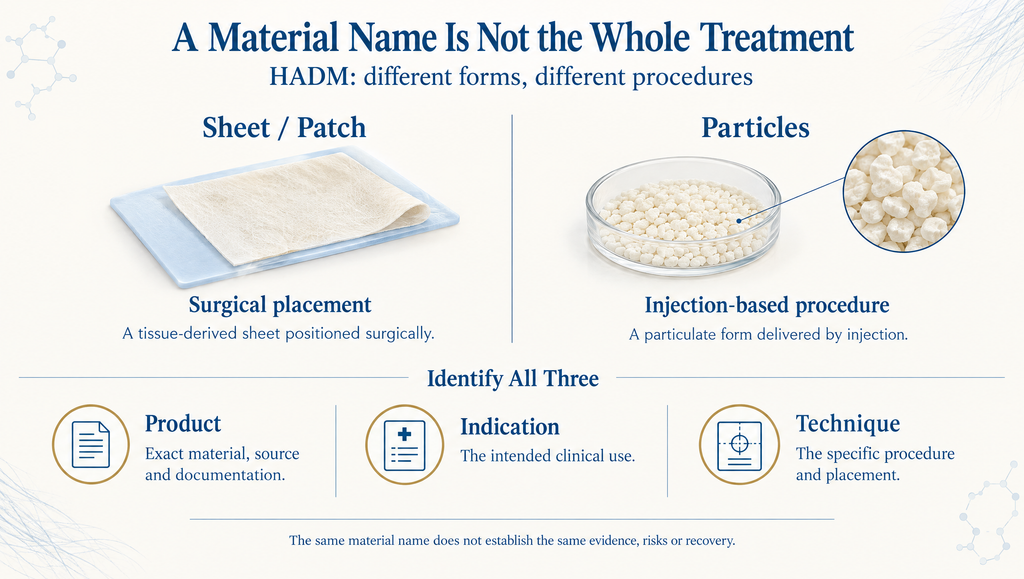
ADM stands for acellular dermal matrix, a processed dermal-tissue material. HADM specifies a human-derived material. These terms identify a category, not a single standardized product with identical performance.
A sheet or patch is placed surgically. Particulate HADM involves a different material form and an injection procedure. They must not be treated as the same operation or assigned the same recovery, tissue response or clinical evidence.
For graft-based cosmetic augmentation, the evidence limitation remains central. Studies of one matrix, one technique or reconstructive tissue repair cannot establish the outcome of a different product used for cosmetic penile enlargement. The intended use, source, product documentation and relevant clinical evidence all need to be clear before any proposal is considered.
A decision about graft surgery cannot rest on a promise of durability alone. Alternatives and no treatment belong in the same discussion, not just different versions of a graft package.
What about HA filler instead of surgery?
Hyaluronic acid filler is an injectable option studied for girth enhancement. It does not require harvesting fat or placing a patch, but its effect is temporary and it has its own risks. A less invasive procedure can still produce swelling, infection, irregularity or an unsatisfactory result.
The choice is not simply “temporary filler versus permanent surgery.” It is a comparison of evidence, material, recovery burden, possible correction and the specific change being sought. Some men will decide that the likely benefit does not justify intervention.
Why previous treatment changes the conversation
A history of injections, implants, circumcision complications or other surgery can affect skin, tissue planes and contour. Adding more volume without understanding what is already present can make a difficult problem harder to manage.
Shinrong’s service includes reconstructive and revision assessment alongside aesthetic procedures. Professor Li’s wider reconstructive background is relevant here: tissue quality and repair options may matter more than achieving an additional measurement. Bring the name of any previous material and your treatment records when possible.
Recovery and possible correction
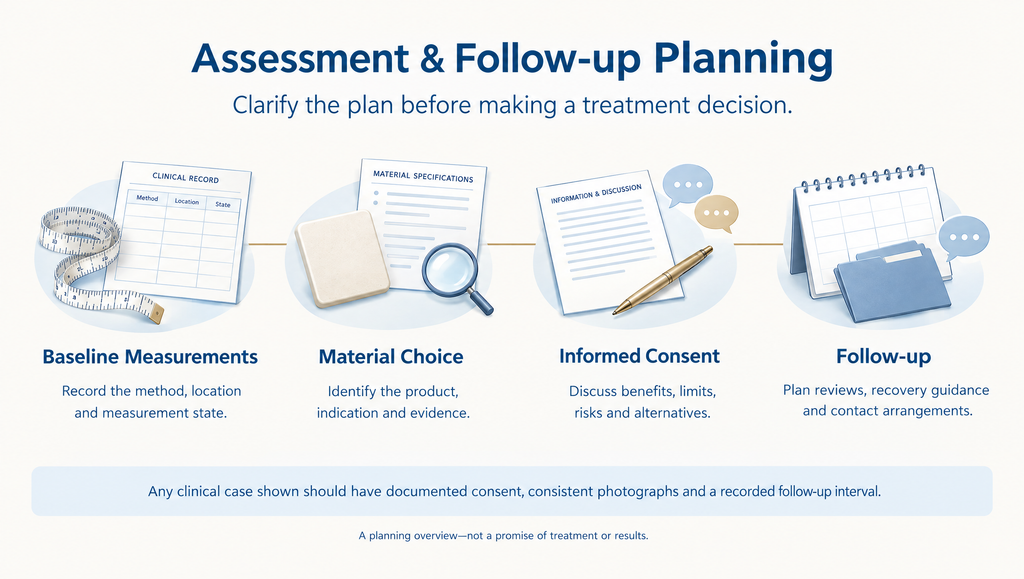
Different surgical approaches require different observation and follow-up. Patch placement, fat harvesting and injection-only treatment should not share a single recovery timetable.
For an operation, the plan needs to cover wound care, swelling, any donor site, restrictions on pressure and sexual activity, and the point at which the result can reasonably be assessed. Fibrosis, painful erections, contour changes, curvature, sensory changes or infection may require further care; some complications can involve revision or removal of material.
Do not massage, compress or attempt to reshape the area without specific clinical instructions. Increasing pain, fever, spreading redness, skin-color changes or urinary difficulty warrant prompt assessment.
Two common material questions
Can a graft be dissolved like HA filler?
No. A graft should not be described as having the same potential response to hyaluronidase as HA. A material-related problem may need a different treatment, including surgery.
Does “biological” mean there is no rejection or infection risk?
No. Tissue-derived origin does not eliminate inflammation, infection, fibrosis or other complications. The exact product, indication and operation matter.
Get a clear explanation before choosing a procedure
Your enquiry can begin with what matters most: circumference, proportion, a previous result or the wish to avoid a particular recovery burden. The next step is to identify the exact option being considered and whether there is a sound reason to proceed.
Contact Chongqing Shinrong Plastic Surgery Hospital
WhatsApp: +86 18983690960
Email: shinronghospital@gmail.com
Online enquiry: Contact Shinrong
- Circumference, proportion and feel—not simply “bigger”
- Start with the type of change you want
- Fat transfer: your own tissue, with a harvesting procedure
- ADM and HADM: understand the product as well as the name
- What about HA filler instead of surgery?
- Why previous treatment changes the conversation
- Recovery and possible correction
- Two common material questions
- Get a clear explanation before choosing a procedure
Consultation does not establish suitability for treatment. Product-specific risks and the limitations of experimental cosmetic graft procedures require full discussion with the treating clinician.

